(Editor’s Note: This column originally appeared in the Portland Press Herald.)
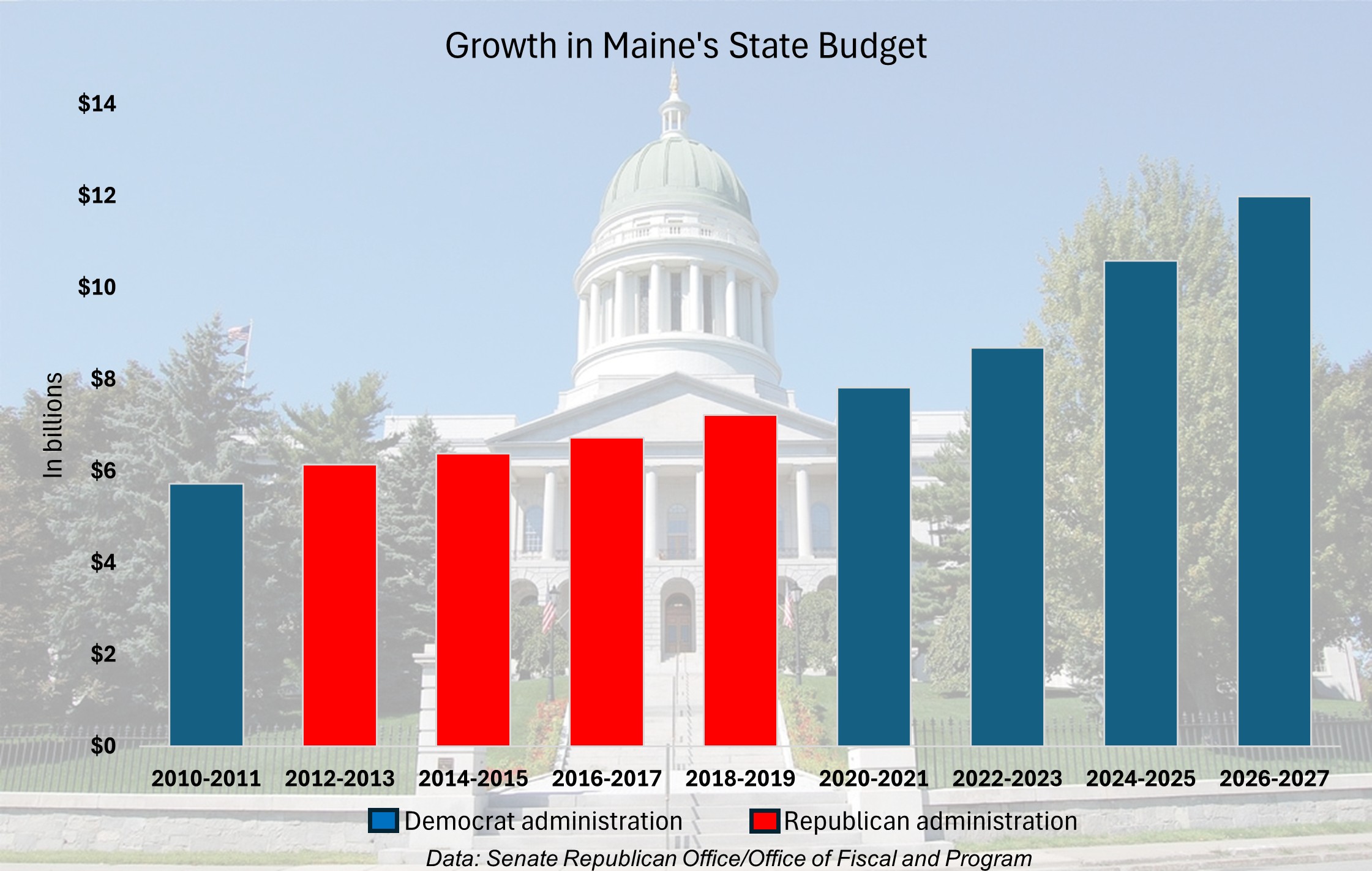
Last month, the legislative majority passed yet another budget that continues their years-long trend of growing our state government at the expense of Maine’s taxpayers. Under one-party control of Augusta, state spending has grown from $7.2 billion in the 2018-2019 biennium to over $12 billion today. While Democrats in Augusta claim all this spending is in response to federal cuts, it really is indicative of an inability to prioritize how taxpayer dollars are managed.
Instead of spending within our means, legislative Democrats increased taxes and raided the Budget Stabilization Fund, our state’s emergency reserve fund, to pay for one-time election year checks to certain eligible residents. This comes after last year’s supplemental budget, which implemented regressive taxes – including a new streaming tax and increasing tobacco taxes – that overwhelmingly affect Maine’s lower-income residents.
The legislative majority did recognize that Mainers are experiencing an affordability crisis. Unfortunately, regarding state spending, that is where my agreement with them ends. My Republican colleagues and I proposed long-lasting solutions to help working Mainers and seniors on limited income keep more of their own money through tax conformity measures, such as no tax on tips or overtime and an increased senior deduction.
These were real affordability measures that would have lasted beyond one-time checks and temporary funding for certain programs. Democrats’ “affordability investments” amount to little more than subsidies that don’t do anything to systemically lower costs or provide relief to the overtaxed Mainers who need it most.
Growing the state budget and increasing taxes is not a sustainable way to ensure affordability. And even with all this increased spending, Maine continues to decline in all the metrics that matter most. Our schools continue to drop in the rankings, even with record funding. Our electricity rates continue to be unbearable, as Maine had the fourth highest increase in rates in 2025. And as the budget has grown by more than two-thirds, Maine’s tax burden has continued to rank in the top five in the country.
So, if more spending – or “investing” as the majority likes to call it – isn’t getting results, why continue to increase taxes? Is it about “tax fairness”?
That’s what legislative Democrats claim is behind their new tax on high-income earners and business owners. If that were the case, why would the over $90 million in new taxes not be used to implement substantive, broad-based income tax relief for working middle-class Mainers? In fact, the new taxes alone would have been enough to fund the revenue lost by adopting some of the most crucial federal tax conformity measures.
The increased taxes and spending are not a reflection of values or a commitment to affordability. They are the manifestation of a Democrat-controlled trifecta of the Legislature and the Blaine House that has been unable to say no to new spending for eight years. And this year they ran out of other people’s money to spend so they had to raise more.

The question is not whether state government should fund important programs. Rather, it’s whether every new program or initiative should be treated as equally necessary. That’s where the majority has failed. When everything is a priority, nothing is. The result is a budget that asks more of Maine’s taxpayers without requiring state government to prove increased spending is producing better outcomes.
A responsible budget would start by protecting core services and ensuring any new spending is sustainable. It would also recognize that the money being spent in Augusta first belonged to Maine’s people. Unfortunately, that is the true disconnect – Democrats firmly believe your money is the government’s to spend as they see fit.
Maine cannot tax and spend its way into affordability. After years of record budgets, new taxes and declining outcomes, it is time for Augusta to take a different approach. That means setting priorities and pursuing broad-based tax relief that helps working families, seniors and small businesses alike.
Senator Matthew Harrington represents District 33, which includes the communities of Alfred, Lebanon, Sanford and Waterboro. He is the Assistant Senate Republican Leader and serves on the Energy, Utilities and Technology Committee and the Legislative Council.

